Showing posts with label picky/resistant eaters. Show all posts

Saturday, January 26, 2013

Mom's Spaghetti Sauce (with Veggies!) for Picky Eaters

When I started writing this post a couple of months back, I was super excited to have finally found a recipe that the entire family would eat.  Other than my red lentil and carrot soup with coconut, which I was getting so incredibly sick of, despite how delicious it is.


 Though I like pasta, I could easily live without it.  So I can't say that I was thrilled at the idea of eating spaghetti so frequently.   But the fact that my kids would eat it made me want to make this every single day, just to simplify my life.  I had finally found a meal that would keep everyone happy and hence, quiet, at meal time.  


look how much he ate compared to the
earlier photo - nothing short of a miracle!!!

Not only did this meal keep my kids happy, but it also got some veggies into them.  What could be better?  This is a one-dish meal, since it has carbs, protein and vegetables all mixed together.  Could life get any better?????  


Logan thought this was so good he had to
lick the leftovers off of his hands ;)
 
This recipe is an adaptation from my mom's fantastic spaghetti sauce.  I modified it a bit to sneak in a few extra veggies and to change the texture to be more picky eater friendly.

The recipe is not overly complicated, but there are a few steps involved and it then needs to simmer for a good hour.  So this is certainly not something you are going to whip up once the kids get home from school.  BUT, it makes quite a big batch and freezes wonderfully.  I divide this into family-sized portions and load my freezer with it.  This is our go-to meal on nights when I've forgotten to take something out, as it tastes just as good defrosted as fresh, defrosts quickly in the microwave and, of course, the pasta only takes minutes to make.

Now, there is certainly no guarantee that all picky eaters will eat this.  In fact, I'm sure that a lot of resistant eaters out there will not.  My kids have only very recently started mixing textures in their foods.  And I suspect that had we taken a different approach to our children's feeding issues, they still might not be trying foods such as these.  However, once your child is beginning to accept foods that mix different textures together, this recipe is a good one to try.


I should also address the idea of hiding vegetables in recipes.  You want to be careful about doing this with very picky and resistant eaters.  I do it now because my kids are too young to realize there is anything hidden.  However, if your child is old enough to notice little green specks here and there, you're probably best to not hide foods.  If your child finds food hidden in a dish where they are not expecting it, you are teaching them that they cannot trust what you tell them about what they are eating.  This will only make a resistant eater even more cautious to put something new into his/her mouth. 


One last thing before I share the recipe - I actually prefer the original version, as I like the chunks in the sauce.  However, I'll tolerate this thinner version as long as it keeps my kids eating!  If you have no picky eaters at home, I'd recommend you check out the original recipe here.

2 lbs. lean ground beef
1 bay leaf
2 10 oz. cans mushroom stems and pieces, including liquid
2 cloves garlic, finely chopped
1 1/2 C finely chopped onion

2 carrots, grated
2 zucchini, grated
1 28 oz. can tomatoes, pureed
1 28 oz. can Bravo spaghetti sauce
2 5 1/2 oz. cans tomato paste
2 7 1/2 oz. cans tomato sauce
2 tsp. oregano
2 tsp. basil
1 tbsp. salt
3 tbsp. sugar
1/4 tsp. pepper
1/3 C grated Parmesan cheese  
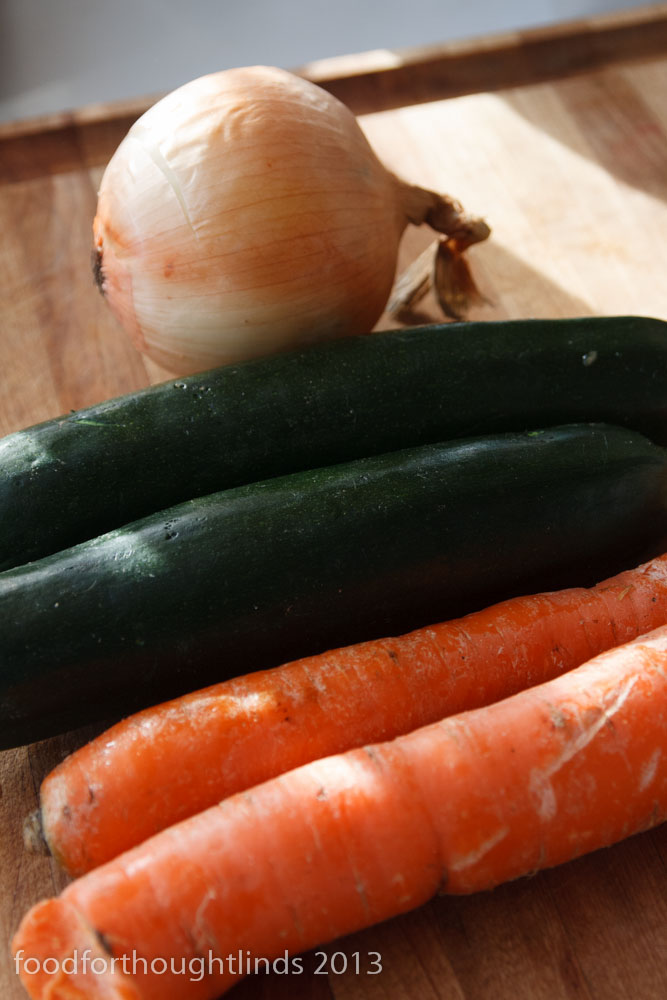


1.  Using a food processor, chop the onion very finely and grate the zucchini and carrots. 


my sous chef

2.  In a large pot (the largest one you have), cook the onion, ground beef and bay leaf until the beef for a few minutes.  While cooking the ground beef, regularly break it down with a fork, so that it is broken into as small of pieces as possible.  Add the grated zucchini and carrot and cook until softened and beef is cooked.  Drain any excess fat.


3.  Purée the mushrooms (including juice) and juice in a blender until very fine.  Also (separately if your blender is too small) blend the canned tomatoes.   


4.  Add remaining ingredients and simmer steadily, uncovered for 1 1/2 hours, stirring frequently.   


To keep this both gluten- and dairy-free, I omit the parmesan and serve it over quinoa pasta.  For a soy-free version, replace the Bravo spaghetti sauce with your favourite spaghetti sauce.

Difficulty level: moderate


Yield: 13 cups

Thursday, September 13, 2012

Ten Tips for Picky/Resistant Eaters

Last weekend, I was at the market, paying for a cart loaded with fruits and vegetables, as Logan stuffed his face with strawberries faster than I could pass them to him.  The lady in front of us looked at my cart and said to me, "wow, he must be the best fed kid on earth".  And I just had to chuckle and think just how ironic it was that she said that.  Little did she know that he had been seen at the Pediatric Feeding Program just the day prior for resistant eating.

I just smiled politely and responded "yeah... he actually doesn't eat all that much".  To which she responded, "well, it looks like you give him lots of opportunities to see you eating good foods.  So I'm sure that he'll start eating well too".

This is the traditional wisdom around picky eaters.  Just keep presenting them with the foods they don't like and they will most likely eventually try them.  And probably even learn to like a few.  Unfortunately, this isn't quite as true for resistant eaters as it is for picky eaters (see here for a distinction between the two).  Though picky eating is a stage that most toddlers go through, without intervention, resistant eating persists beyond the toddler years.  Just being patient and waiting it out doesn't work with these kids.

The reason is that (at least in my opinion), a lot of these resistant eaters have some sort of issue that has contributed to feeding difficulties:  be it sensory problems, oral-motor difficulties, reflux, food intolerances, celiac disease, etc.

These kids need a special approach to encourage them to increase the types of foods they will eat over time.  Though people always say that a child will not starve themselves to death, in fact, 4-6% of children will not eat, regardless of their level of hunger (either because it is just too difficult for them, or because it hurts them too much).  


I wanted to share some of the tips for picky/resistant eaters that we've picked up along the way, to help out others who are experiencing feeding challenges with their little ones.  As much as we learned them in the context of our little resistant eater, I'm sure they'd be helpful for picky eaters too.

Our OT mentioned that there are 32 steps that a resistant child needs to go through before they will accept to eat a new food.  So clearly, eating can be a complex process for these children.  If you don't respect letting them slowly work their way up the hierarchy of steps, you are not going to be successful in having them accept new foods. 

Now, I don't know all of the steps just yet.  We are still learning and I'm sure that I'll do another post down the line as we learn new strategies to help our little guy.  But I wanted to share some of the things we have learned so far that have worked well for us.  We've gotten some of this info from our OT and some from the book Finicky Eaters:  What to do When Kids Won't Eat.  These are not things that you will necessarily have to do with every child.  But if your child is struggling with eating, I am pretty convinced that trying to incorporate some of these techniques might help.  Or, at least, it did for us.

1.  It is up to the child what and how much he eats.  No pressure should be placed on the child regarding whether or not he is eating or what he has chosen to eat from his plate.

I put this point first, as I feel that it is the cardinal rule.  If you don't follow this one, I think that you're only heading for more trouble with these tough kids who are already digging in their heels, not wanting to eat.

As I remember reading somewhere, it is your job as a parent to provide adequate and nutritious food to your children.  It is entirely the child's responsibility to decide whether or not to eat, what to eat of the foods that are offered, and how much.

I cannot tell you the number of times I have bit my lip, or perhaps even made a quick comment as someone sitting with us has repetitively said to Logan, "eat your chicken, Logan".  Eating needs to be pressure-free.  A non-issue.  You don't want to give any attention to what or how much the child is eating.  

Now, of course, I still pay attention to these things.  But I don't let on to Logan that I am paying any attention at all to his eating.  My attitude towards him is, "Eat if you want, don't if you don't.  That's fine."  Said in a way that conveys that he truly has the control regarding these decisions and that it's not secretly annoying me (even if sometimes it is!).  By the time he was maybe just past a year old, I had learned that he'll eat when he wants and that's just that.  And the recent feedback from the psychologist was that this was the perfect approach to take.  So if you are having struggles with your child not eating well and haven't taken this type of an approach yet, it's probably the first thing you want to try.

2.  Never, EVER put something into your child's mouth without his/her consent. 

This point ties in closely with point #1.  It is up to your child to determine whether or not he wants to eat.  Forcing him to eat something that he doesn't want to eat is only going to turn things into a power struggle and won't get you anywhere.  Imagine if someone randomly shoved something in your mouth that you didn't want to eat.  I'm sure you wouldn't be too happy either!!  

3.  Let your child play with his/her food.

Children need to be familiar with a new food before they will be willing to put it in their mouth.  We have let Logan play with his food from the get-go, but our OT has confirmed that this was a great thing to do.  We don't have many limits on what he does with his food, as long as he's not throwing it around the kitchen!!  In fact, sometimes McQueen and Mater even eat some of the foods that he doesn't want to.  

The psychologist who we recently saw the Feeding Clinic told us that she doesn't disagree with these types of techniques to help encourage feeding, and is also aware that this is a typical OT technique.  However, she also commented that we need to understand that this will create eventual behavioural challenges.  This was already evident to me.  At some point, we will have to lay our foot down with a "no more toys at the table" rule.  And I'm plenty ready to do that, once he is eating well.  In the meantime, I'm willing to allow it, on the grounds that it will apparently help him become more comfortable with putting new things in his mouth.

4.  Only put one new food on your child's plate at a time.

This helps decrease the child's anxiety with respect to trying new foods.  Given that there is no pressure to eat specific foods, the child can become exposed to a new food (repetitively), while still having enough food on his plate that he accepts eating.  

Our OT mentioned that, for these picky/resistant eaters, each way a food is cut or cooked is considered to be a "new food".  For instance, if the child eats steamed whole baby carrots, raw baby carrots, shredded carrots and diced carrots (raw or cooked) would all be considered to be a "new food".  So even though the child eats steamed whole baby carrots, if you steam baby carrots and cut them into pieces, this needs to be placed on the plate as the new food, alongside other foods the child already eats willingly.  

5.  Serve only a very small portion of new foods.

This way, your child will not feel overwhelmed at the prospect of a mountain of food that he doesn't like on his plate.  Keep in mind that you want to be serving a small child-sized portion and not a small portion for an adult.  For instance, when we introduced corn, I probably put 5-8 kernels on Logan's plate.  The child can always ask for more if they eat everything.  And you can progressively increase portion sizes as the child accepts the new food.
 
6.  Keep a little bowl on the side of your child's plate where he can put any foods that he doesn't want to be on his plate.

If the child won't accept a certain food on their plate, serve that food on their plate, but let them know that if they do not want to keep that food on their plate, they are welcome to put it into the bowl instead.  If they do not yet tolerate touching the food, encourage them to use a fork or other utensil.  The child will eventually come to tolerate the food being on their plate.  We were lucky that Logan began tolerating disliked foods on his plate very quickly after we introduced this.  Though I am sure there are other children who will be more resistant.

7.  Use a divided plate. 

My sister got Logan a "construction plate" for his birthday.  Which is essentially a fun divided plate with some fun utensils. This helped us immensely.  More than I could have imagined when she gave it to him.  The minute a piece of corn or a pea gets out of its own compartment, Logan's right there, guiding it back to its home.

8.  Model eating and enjoying varied foods.

In order to encourage Logan to try new foods without putting any specific pressure on him, we often talk about what we are eating during meals.  For instance, I may say to my husband "mmm, daddy, these peas are so good!  Do you like them too daddy?".  To which my husband will obviously respond "mmm... so good".  Now, clearly, this will only work with toddlers.  When Chloé is eating something new, I'll comment, "Look!  Chloé's eating a muffin!  She likes the muffin."  Without making it into a criticism that Logan won't eat that food or making it into a competition.  I simply say it as a passing comment.  And sure enough, he will sometimes pick up something new to try.  Sometimes, he picks it up, moves it towards his mouth and says "no".  And that's fine too.

8.  Use shaping to progressively work towards your feeding goals.

There is a bit of a pervasive belief in our society that when a child does something they shouldn't, they need to be told 'no', punished and told what they should have done.  While I don't disagree that children need both limits and consequences, there is no question in my mind that positive reinforcement is a much stronger tool than punishment.

We try to steer clear of any criticisms of what Logan isn't doing well at the table, but rather, reinforce any approximation of the behaviour we are working towards.  For instance, the other day when Logan picked up a cucumber and put it back down, I said to him "I like how you just picked up your cucumber".  Clearly, I would love for him to eat the darned thing.  But picking it up is one step closer to eating it than leaving it on his plate is.  

We will also make a really big deal out of him trying anything new.  For instance: "Daddy!  Did you see that??  Logan tried some peas!".  Or if he eats a lot of something he typically won't eat, I'll say to him, "Logan!!! Did you eat that all??", in disbelief:


The trick here is to use baby steps to work towards what you ultimately want the child to do.  And to praise, praise, praise every time the child gets one step closer.  This is something I know almost innately, from my career as a Speech-Language Pathologist.  And it can work for essentially any behaviour, if done consistently.  

The balance of positive to negative reinforcements should always be a minimum of 10:1.  Pay attention to your verbal interactions with your children.  Parents' instincts tend to be to comment on what the child is doing wrong.  For instance, to say "no pushing", instead of saying "gentle hands", or "I like how you were gentle with your sister".  For each time you give your child a negative reinforcement, such as "no pushing", he should hear 10 positive reinforcements.  And quite, honestly, I doubt there are many parents who meet that criteria (my husband and I included).  But we can do our best to strive towards this.

9.  Without putting too much pressure on the child, encourage him to try new foods - while redefining the meaning of the word "try".

"Trying" a new food does not necessarily mean putting it in your mouth and swallowing it.  There are many steps to get a child to eat a new food.  And you need to work your way up the hierarchy of these steps to get the child to accept trying the food.  You need to do something that is only one step more difficult for the child than what they can currently tolerate.  This is the only way that you will experience any success.

For instance, if the child cannot yet tolerate being in the same room as a food, expecting the child to eat that food is much too advanced of a goal.  A more reasonable goal would be working towards getting the child to accept being in the same room as that food, even it is has to be at the opposite end of the room.  If a child will not yet tolerate a food on his/her plate, that would be a reasonable goal to work towards, even if it only remains on the plate for a few seconds.   


For picky eaters, there can be up to 25 steps to work towards, in order to get the child to eat a new food.  For resistant eaters, there are up to 32 steps.  You need to analyze where your child's current comfort level is.  Some of the steps that can be encouraged with the child include:

  • smelling the food
  • touching the food with a finger
  • handing the food to someone else
  • kissing the food
  • licking the food
  • using the food as a "tool" for other foods (i.e. if the child doesn't eat carrots, but eats hummus, getting them to eat hummus off the the carrot without having to eat the carrot)
  • putting the food in the mouth and then spitting it back out
  • putting the food in the mouth and playing with it with your tongue
  • putting the food in the mouth, chewing it and then spitting it out
You can find more detailed information on these steps here.

We have been fortunate enough that we haven't had to do every step on the hierarcy.  We started by using a bowl next to his plate to get him to tolerate new foods on his plate.  From there, we were able to go straight to kissing foods.  We have had a routine of kissing all of our foods goodbye before we put them in garbage.  


You can see in the above video that Logan doesn't love the feeling of the foods on his lips, but he will tolerate them.  So we continue doing it, all the while praising him for kissing them. Logan very quickly started trying waaaaay more new foods when we began this kissing.  Some days, he would kiss something and then immediately say "Logan try" (which just flippin' blew me away!!).  This is how he fell in love with his new best friend, "guaccoli" (guacamole).  In fact, this is also how he began eating hummus, carrots, watermelon, peaches, red lentil soup... the list goes on. 

As a side note, had Logan not been tolerating the kissing relatively well, he would have been the one holding the spoon.  But this video was taken when we had already been doing this for awhile.


P.S.  Notice how he asked for dessert at the end of each video?  He so knows kissing is part of the routine to get him dessert.  As much as I did not want to EVER use dessert as a reward, we have been encouraged to do so by our OT, to help encourage him to do whatever step we are working on (i.e. kissing). 

We are now working more on having him hold things in his mouth for a second and spit it out.  He's more reluctant to do this, but we've managed to get him to do it a few times.  We make it into a game.  We all do it at the table and he ends up giggling and, often times, joining in.

In any case, each parent needs to decide what step is appropriate for their own child.  Keep in mind that, in choosing an appropriate stage, you need to consider not what you want the child to be able to do, but what he/she is currently able to do.  And you then need to pick a step that is only slightly more advanced than what he/she is able to do now.  If you pick something that is much more advanced than what the child is already able to do, you will be setting him up for failure.  This will only lead to increased stress for the child and the parents.

10.  For children with oral hypersensitivity, use desensitization techniques to increase tolerance of food in the mouth.

One last tip that is probably only pertinent to children who are having feeding issues due to sensory problems.  Logan's issues are related to a hypersensitivity in his mouth.  The feel of food in his mouth bothers him much more than other people.  Because he can actually feel the food in his mouth much more than we can.  He can gag and throw up on something as simple as a little piece of cracker in his mouth.  

In order to help desensitize his mouth, OT recommended we use a disposable vibrating toothbrush and start brushing the inside of the cheeks, tongue, palate, etc. You let them do it first and only do it if they accept it. No forcing of anything.  If the child does not yet accept a vibrating toothbrush, you can try brushing the inside of the mouth with a regular toothbrush.  And if the child won't let you do it, try to encourage them to do it themselves.  There also exist a few chewy toys that can help desensitize the mouth, such as the Nuk brush or chewy tubes.  We purchased a few of each of these so that the kids can always be wandering around the house, gnawing on these, giving themselves their own occupational therapy.

So there you have it.  This is what I've learned so far.  And I'm sure there will be lots more to come.

Using these techniques have gotten us a long way so far.  Like here:


and here:


 and here:


And, my absolute favourite, here:


And last night, Chloé even ate some red lentil and carrot soup with coconut milk (with the veggies puréed/grated) followed by a peach muffin.  And I almost died!

Tuesday, September 4, 2012

The Difference Between a Picky Eater and a Resistant Eater

As I mentioned before, we've been seeing a lot of feeding changes around here lately.  In fact, I feel like we have been seeing monumental changes over the past couple of weeks.  Logan has been eating like a champ.  In fact, I feel like he does nothing BUT eat these days.  What a change!!  Chloé's had a bit of an insatiable appetite for everything these days too.

Yesterday, while we were apple picking, Logan ate 4 apples.  

No, that is not a typo.  

He actually ate 4 apples!!!  Including the skin!  

This is the kid who wouldn't even consistently eat an apple a few weeks ago.  He has, on a few completely random occasions, eaten the odd apple - but he generally refuses them when offered one.  Time will only tell if apple picking was just special incentive to eat some this time...

that's right - two at a time!!!
He has also miraculously begun loving corn on the cob this week:


This is the child who, up until recently, ate a very limited selection of foods and refused to try anything new.  At all.  Well, unless it was a new kind of cracker.  Or cereal.  Or ice cream.  And he would throw such wicked fits if we didn't just give him his preferred foods (such as hot dogs and crackers). 

I'm sure that some of these changes are due to tips we have gleaned from our OT, and from the book Finicky Eaters: What to Do When Kids Won't Eat, which our OT recommended to us.  

But I have to admit that I also feel that his eating has changed drastically since we cut gluten and dairy from his diet.  My gut tells me that the elimination of these foods has also contributed to the recent massive changes in eating we have been seeing lately.  I'm suspecting that he is truly intolerant to something or other.  But we will only know for certain whether or not he has any food intolerances once we have reintroduced these foods, in a few more weeks.

These days, I feel like Logan is almost more of a typical picky 2 year old than a resistant eater.  He now tolerates most anything on his plate, even if he doesn't always touch or taste it.  He doesn't gag on food nearly as much as he used to and he hasn't vomited while eating at all lately (thank goodness!).  He is sometimes willing to try new foods on his own.  In fact, he has incorporated the word "try" into his vocabulary, which is huge.  He actually asks us to let him try things now!! (as if we wouldn't!).  We can also sometimes negotiate with him to get him to try a tiny, tiny bite of things he doesn't want to.  And he doesn't freak out when he doesn't get exactly what he wants on his plate the way he used to.  

Mealtimes, though still noisy and chaotic, are much less stressful than they used to be, as he will often sit and eat little bits here and there instead of running around in a screaming, tantruming mess. 

In a later post, I will share some of the tips we have learned that have helped improve his eating.  

But first of all, I wanted to explain the distinction between a picky eater and a resistant eater.  This information comes from the book Finicky Eaters.  

Picky eaters don't eat a huge variety of foods.  They don't like to try new foods.  They have favourite foods that they prefer eating and complain when this is not what is served.  It is quite typical of toddlers to be picky eaters.  And I'm sure that every one of you can think of an adult you know who you would consider to be a picky eater. 

Resistant eaters are further down the severity continuum than picky eaters.  They are picky eaters to the extreme.  We are now in the realm of dysfunction.  Ernsperger and Stegan-Hanson (2004) have stated that "resistant eaters typically have an extreme reaction when presented with new or novel foods that continues even as they grow older".

Picky eaters, in comparison, are less intense in their food choices and in their reactions to novel foods.

The characteristics of a resistant eater are as follows (child demonstrates one or more of the following):

1.  Limited food selection.  Total of 10-15 foods or less.
2.  Limited food groups.  Refuses one or more food groups.
3.  Anxiety and/or tantrums when presented with new foods.  Gag or become ill when presented with new foods.
4.  Experiencing food jags.  Require one of more foods be present at every meal prepared in the same manner. 
5.  Diagnosed with a developmental disorder, such as Autism, Asperger's Syndrome or Pervasive Developmental Disorder-Not Otherwise Specified.  May also have a diagnosis of mental retardation.

Before I read this book, I knew that Logan was a picky eater.  And though I found his eating patterns caused stress in our lives, I didn't necessarily understand that it was abnormal or problematic.  I mean, my gut told that me it was, but everyone kept telling me that toddlers are picky and that it's just normal.  So I was somewhat conflicted between what my gut was telling me and what I was hearing from everyone else.

When I read this book, there was no more denying the obvious.  Logan met all of the last 4 criteria (for number 5, I considered diagnosis with a sensory processing disorder to meet this criteria).  And in terms of the different food groups he ate - at the time I read the book, he would not consistently eat any fruit other than bananas, any vegetables or any meats.  So starches and dairy were really the only food groups he would accept to eat. 

I realized that I was dealing with a resistant eater.

Not much of a surprise.  Logan's been a bit of a resistant everything ;)


Plus, being a resistant eater is very common in children with sensory processing disorder.  Some have issues with the texture of food, some with the flavour (some kids don't like anything with flavour, others crave intense flavours).  And still other kids have issues with the temperature of food (disliking or craving things that are hot/cold).

I have had people frequently tell me that if we were just "tougher" with Logan... more strict and the like... that he would just eat more.

Thing is (and my gut already knew this), pushing a resistant eater to eat... it just won't work.  It'll only make things worse.  These well-meaning people have clearly never actually dealt with a resistant eater.  But in an upcoming post, I'll give you some tips that will actually help you to get them to eat a bit more.